From Learning to Doing: Transforming Subjects Through STEM
In today’s rapidly evolving educational landscape, preparing students for the future requires more than traditional teaching approaches. Classrooms are no longer spaces where students passively receive information - they are environments where learners are expected to think, create, and solve real-world problems.
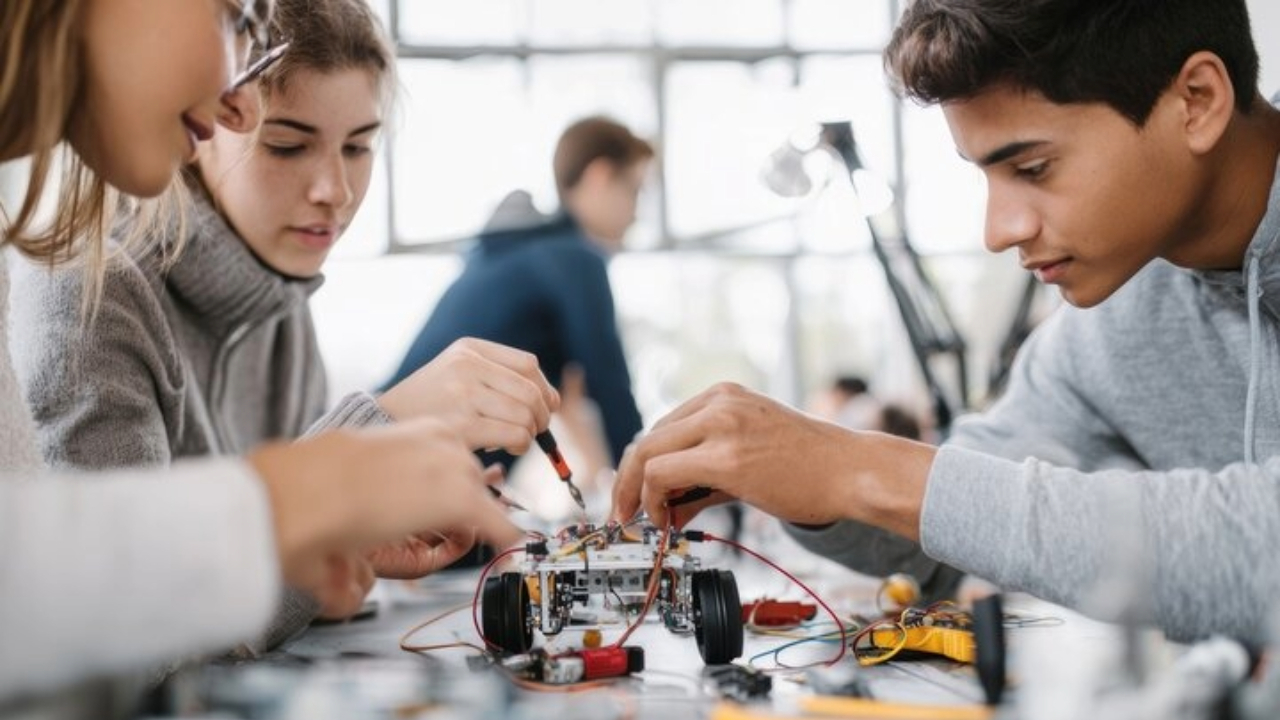
During one classroom session, a group of students were asked to program a robot to move across a grid. What seemed like a simple robotics task quickly turned into a mathematics lesson - students began calculating distances, adjusting angles, and debugging their logic. Without realizing it, they were applying mathematical concepts through hands-on learning. This is the power of STEM integration.
From Theory to Real Practice
Many educators recognize the importance of STEM but often ask:
How can we realistically integrate it into daily lessons?
Do we need to redesign the entire curriculum?
The answer is no.
STEM integration does not require major structural changes. Instead, it requires a shift in teaching approach - moving from isolated subjects to connected learning experiences.
Using classroom-friendly robotics tools, teachers can transform traditional lessons into interactive, problem-solving experiences. For example, in a science lesson on motion, students can program robots to explore speed and direction. In a language lesson, students can design storytelling sequences using robots as characters, reinforcing both creativity and logical thinking.
Integrating Across Core Subjects
The strength of STEM lies in its flexibility across disciplines:
Mathematics
Students program robots to follow paths, measure distances, and explore angles—turning abstract concepts into visible and testable outcomes.
Science
Concepts such as force, motion, and energy become interactive as students observe how robots respond to commands and environmental changes.
English / Literacy
In one classroom activity, students created stories where robots “traveled” through different scenes. They wrote instructions, sequenced events, and presented their ideas— combining communication skills with structured thinking.
Social Studies
Students can simulate historical journeys or geographic exploration, transforming static content into engaging, interactive experiences.
Arabic & Identity Subjects
Technology becomes a bridge between modern skills and cultural identity, allowing students to express language and heritage through innovation.
Developing Future-Ready Skills
Beyond subject knowledge, STEM integration develops essential skills for the future:
• Critical thinking
• Problem-solving
• Collaboration
• Creativity
• Digital literacy
• Engineering mindset
These skills are not developed through memorization - they are built through experience.
This approach strongly aligns with Saudi Arabia’s Vision 2030, which emphasizes innovation, technology, and preparing students for future careers.
Practical and Scalable for Every School
A common misconception is that robotics integration requires advanced infrastructure or significant financial investment. In reality, effective implementation can begin with simple tools and structured lesson design.
Teachers can start small - integrating robotics into one lesson per week - and gradually expand. With proper support and training, schools can adopt STEM in a sustainable way without disrupting their existing curriculum.
From Classroom to Real Impact
When students engage in integrated STEM learning, their mindset changes. They move from passive learners to active creators. This often extends beyond the classroom into competitions, innovation projects, and collaborative challenges.
More importantly, students begin to understand not just what they are learning, but why it matters.
Conclusion
Integrating STEM and robotics into core subjects is not an additional layer - it is a transformation in how learning happens. By connecting disciplines, encouraging hands-on exploration, and focusing on real-world application, educators can create classrooms that prepare students not only for exams, but for life.
Author
Eng. Hiba Ekhlassi Head of Robotics and STEM Education Al-Faris International School, Riyadh Featured Speaker at GESS Saudi, EduTech Asia, and Saudi STEM Conference Certified Trainer in AI, Robotics, Cybersecurity, and STEM Education
Stay up to date
Subscribe to the free GESS Education newsletter and stay updated with the latest insights, trends, and event news every week. Your email address will remain confidential