Every Transition Matters: Building an Inclusive Transition Framework from Early Years to Secondary
A child’s first day in a new classroom can tell us a great deal about how well a school understands inclusion. Moving from Early Years into Primary brings new routines, expectations, and relationships. For a child who relies on familiar ways of communicating or receiving support, continuity matters from the first morning.

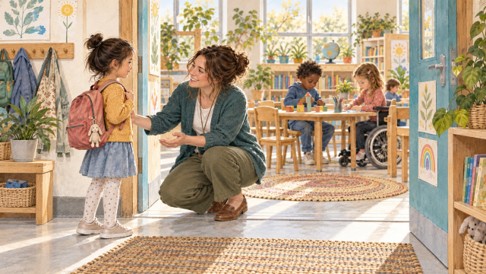
A welcoming classroom helps children approach a new beginning with confidence.
Having worked across international education systems, I have seen how much attention schools give to curriculum, assessment, and student support. Transitions can expose the gaps between those systems.
From Handover Records to Classroom Support
Consider this hypothetical scenario. A school leader notices that handover records capture attainment but overlook the approaches that help students learn. The leader schedules teacher conversations informed by students’ and families’ priorities. For one learner, the team agrees on a named adult, an advance classroom visit, and timetable practice. At a two-week review, they ask whether the student knows whom to approach and whether mornings feel more manageable at home. If difficulties remain, the team adjusts the plan. The leader ensures each action has an owner and that support reaches the classroom.
To make this kind of coordination routine, I propose five stages: Prepare, Connect, Support, Monitor, and Review. This proposed framework draws on transition research and offers a practical structure for school teams, but it has not been evaluated as a complete program.
Transitions Are More Than Administrative Events
Beatson et al. (2023) reviewed 26 studies of interventions supporting the move from Primary to Secondary. Most interventions improved at least one relevant outcome, but the authors called for stronger evaluation and replication across educational contexts.
Snozzi (2026) examined a different transition: movement between mainstream and special education placements. Across 23 studies, transitions were often stressful, and findings pointed to the value of adapting environments and supporting skills. Most studies were small and qualitative, so these findings should guide thoughtful planning rather than promises of success.
A Five-Stage Framework for Inclusive Transitions
Use the stages as a repeating cycle: what a school learns during Review should shape how it prepares for the next transition. The process stays consistent while the support responds to each learner.
For younger learners, preparation can include classroom visits, photographs of new teachers, visual schedules, and practice with unfamiliar routines.
For students entering Secondary, rehearse the timetable, explore the campus, introduce a peer mentor, and discuss growing independence. Ask students what they are looking forward to and what worries them.
For international arrivals, including mid-year admissions, check language needs, previous curriculum coverage, and opportunities to make friend
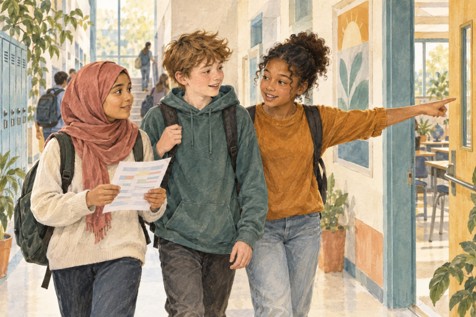
Finding their way together: peer support during the move to Secondary.
Assessment results tell only part of a student’s story. Receiving teachers also need to know their interests, communication preferences, successful strategies, and agreed adjustments.
Then and Pohlmann-Rother (2024), drawing on interviews with 22 preschool educators, identified communication, coordination of support, and joint professional learning as dimensions of cooperation around school entry for children with disabilities.
Set aside time for the sending teacher, receiving teacher, and relevant specialists to talk. A short, useful learning profile should support that conversation.
What does the next teacher need to know to help this student succeed from day one?
Families know what creates anxiety and which routines help their child feel secure. Students should also help identify the support they want.
In interviews with six parents and seven kindergarten teachers, Sands and Meadan (2024) found that limited communication, late teacher assignments, and differences between settings complicated transitions for children with disabilities.
Agree on early support, identify a named contact, and offer interpretation when needed. Use visual schedules, familiarisation visits, or adult assistance as needed, and review them as confidence and independence develop.
A student can complete assignments while feeling isolated. During the first weeks, ask about friendships, routines, safety, and where to find help.
Bring student and family feedback together with attendance, participation, and learning evidence. Identify who will follow up on concerns and when. Good marks alone do not show that a transition has gone well.
Check whether agreed adjustments actually happened and whether they helped. A useful starting point is a review after two weeks and again after six, adapted to the learner; these are suggested checkpoints, not research-established deadlines.
Include students, families, teachers, and support staff. Change what is not working, record responsibilities, and use the lessons to improve the next transition.
International Schools Face Additional Challenges
An international move may bring a new country, language, curriculum, and set of cultural expectations at once. Explain unfamiliar school routines and invite families to share how support worked previously.
Don't automatically treat difficulty with a new language or curriculum as a learning disability. Equally, language differences must not obscure additional needs. Build a picture of the learner across languages and settings, using family knowledge and appropriate specialist input.
Leadership Makes the Difference
Leaders must make this work possible through protected handover time, clear responsibilities, staff development, and access to support.
Before the next intake, choose one upcoming transition and check the arrangements with the receiving team. Confirm who will coordinate support, what information is still missing, and when students and families will be heard.
A consistent process should make individual support more reliable across Early Years, Primary, Secondary, and mid-year admissions.
Every Transition Is an Opportunity
Every transition offers a chance to strengthen belonging and independence. Preparation cannot remove every uncertainty, but it can ensure that a child has someone to turn to.
Before a student walks through the door, the receiving team should know what helps them learn, who will support them, and how concerns will be followed up. Inclusive schools prepare students for their next classroom, and prepare the next classroom for their students.
References (APA 7th Edition)
Beatson, R., Quach, J., Canterford, L., Farrow, P., Bagnall, C., Hockey, P., Phillips, E., Patton, G. C., Olsson, C. A., Ride, J., McKay Brown, L., Roy, A., & Mundy, L. K. (2023). Improving primary to secondary school transitions: A systematic review of school-based interventions to prepare and support student
social-emotional and educational outcomes. Educational Research Review, 40, Article 100553. https://doi.org/10.1016/j.edurev.2023.100553
Sands, M. M., & Meadan, H. (2024). Transition to kindergarten for children with disabilities: Parent and kindergarten teacher perceptions and experiences. Topics in Early Childhood Special Education, 43(4), 265–277. https://doi.org/10.1177/02711214221146748
Snozzi, R. (2026). Transitions between school placements for students with special educational needs: A scoping review. International Journal of Educational Research, 140, Article 103060. https://doi.org/10.1016/j.ijer.2026.103060
Then, D., & Pohlmann-Rother, S. (2024). (Multi-)Professionelle Kooperation beim Übergang von Kindern mit Beeinträchtigungen in die Schule. Kooperationsprozesse aus Sicht der Fachkräfte [(Multi-)Professional cooperation in the transition to school of children with disabilities. Cooperation processes from the perspectives of preschool teachers]. Zeitschrift für Erziehungswissenschaft, 27(4), 923–952. https://doi.org/10.1007/s11618-024-01232-9
By Dr. Emanuel Vincent | Head of School & International Education Leader
GESS Education | GESS Dubai 2026
Stay up to date
Subscribe to the free GESS Education newsletter and stay updated with the latest insights, trends, and event news every week. Your email address will remain confidential