Why the Foundations of Education Begin Long Before School
Before a child ever walks through a school gate, the foundations of learning are already being built.
That is one of the most important truths in education, yet it is still too often overlooked. We tend to measure learning only once children are expected to sit, listen, read, write, concentrate, and achieve. But by then, the brain and body have already spent years laying down the systems that make those later demands possible. Early childhood is now widely recognised as a crucial window in which the foundations for lifelong learning, wellbeing, health, and development are established.
This is why the years from zero to three and three to six matter so profoundly. These are the years in which the brain develops at extraordinary speed. Neural pathways are formed and strengthened through repeated experiences, responsive relationships, movement, sensory input, and play. Children are not simply learning during these years; they are building the brain architecture that allows later learning to happen.
I explain this through what I call the bucket of knowledge. Imagine trying to pour water into a bucket full of holes. No matter how much you pour in, the water drains away. This is what education looks like when we focus on academic content, before developmental foundations are secure.
In my own training, that bucket begins with a clear sequence: primitive reflexes sit at the bottom, sensory integration comes next, and movement is the vehicle through which both are developed.
At the very bottom of the bucket sit primitive reflexes. These are the earliest automatic movement patterns that support survival, birth, feeding, early posture, and neurological organisation. They are essential in the earliest stage of life, but they are not meant to remain dominant. They are meant to be integrated so that more mature, voluntary, and coordinated patterns can emerge. When that does not happen well, retained reflexes can interfere with posture, balance, eye tracking, coordination, sensory regulation, emotional control, behaviour, and attention. Recent research has reported a significant correlation between ADHD and retained primitive reflexes.
The second foundation is the integration of the eight senses. Most people think only of the five familiar senses: sight, hearing, touch, taste, and smell. But children’s readiness for learning also depends heavily on the vestibular, proprioceptive, and interoceptive systems. These help children know where their body is in space, how much force to use, how to balance, how to coordinate movement, and how to interpret what is happening inside their own body. When these systems are not well integrated, children may appear fidgety, clumsy, avoidant, inattentive, impulsive, or emotionally overwhelmed. What is often labelled as a behaviour problem can, in many cases, be a foundation problem.
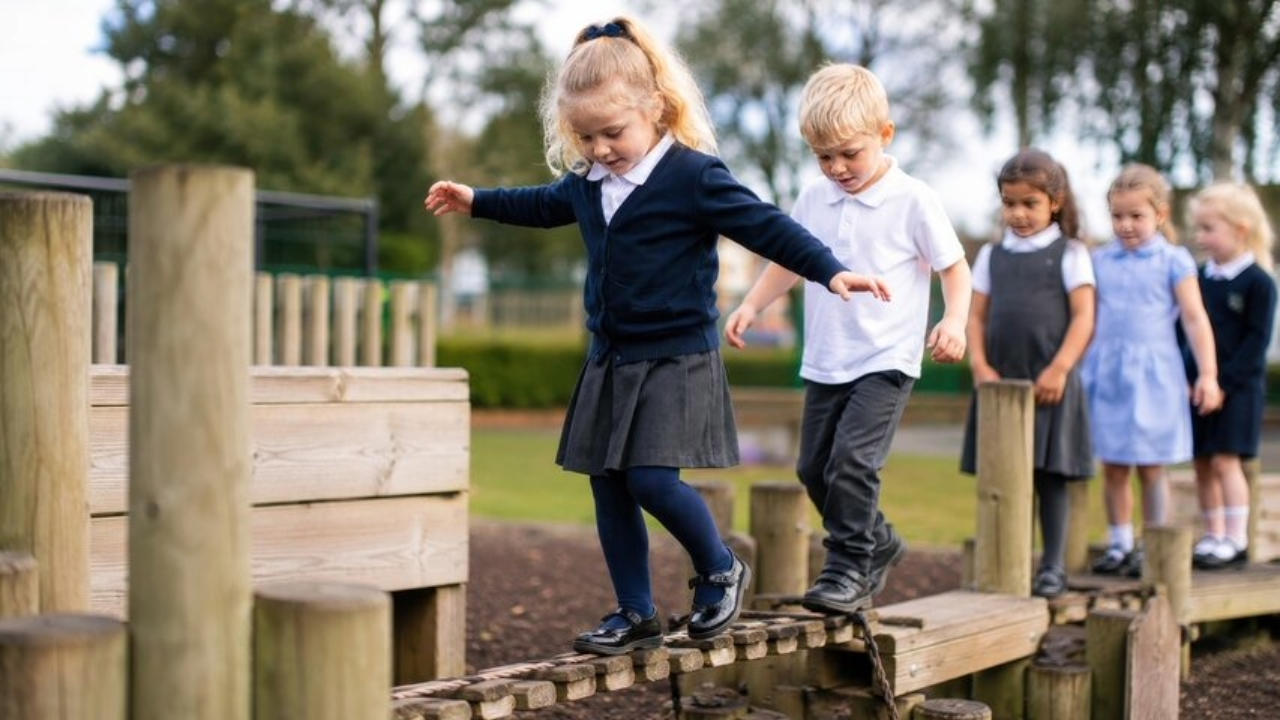
This is why movement is not an optional extra. Movement is the vehicle through which these foundations are built. Movement helps primitive reflexes integrate. Movement stimulates and organises the sensory systems. Movement develops posture, balance, body awareness, bilateral coordination, spatial awareness, and motor planning. Through rolling, crawling, climbing, swinging, spinning, balancing, hanging, pushing, pulling, jumping, carrying, digging, and free play, children are giving their brains the input needed to build strong neurological foundations. Guidance for children under five is clear that they need substantial active play, less time restrained in seats and prams, and limited screen-based sedentary time because these behaviours are central to healthy development and wellbeing.
Yet this is where the modern world has changed childhood dramatically.
Over the last 10 to 15 years, many children have spent more time in cars, prams, seats, and in front of screens, and less time outdoors moving freely through play. Many are not getting enough opportunities to crawl through spaces, climb, run on uneven ground, spin, hang upside down, balance, dig, roll, carry, and explore nature in the way previous generations did more naturally. When those movement opportunities decrease, the consequences are not only physical. They are neurological. Children lose repeated experiences that help organise reflexes, strengthen the sensory systems, and wire the brain for later learning.
The evidence around early screen exposure should make us pause. Recent studies have found that increased screen time in early childhood is associated with poorer developmental outcomes, and that more screen time in children aged 12 to 36 months is associated with fewer adult words, fewer child vocalisations, and fewer conversational turns with caregivers. In other words, children are not only moving less. Many are also experiencing fewer of the rich, responsive interactions that help build language, connection, and learning.
We should not be surprised, then, that more children are being described through labels linked to behaviour, attention, social and emotional regulation, motor coordination, and learning difficulty. Too often, education responds at the level of the visible symptom. But what if many of these children are not showing us a lack of ability, but a lack of foundation?
This is also why the conversation around education must change to ensure that no child is left behind. Parents, teachers, and educators need to understand how children develop and reflect carefully on their teaching practices, environments, and methods to ensure children are developmentally ready for academic learning. Too often, we expect performance before readiness. Yet when we fail to build the foundations first, we increase the risk of children struggling, being misunderstood, and being labelled for difficulties that may have been prevented through the right developmental support.
We do not build the roof of a house before laying the foundations. The brain is no different. When the foundations are strong, Knowledge stays. Learning deepens. Confidence grows. Behaviour settles. The child is far more ready for the demands we place before them.
That is why the real foundations of education begin long before school.
If we are serious about changing outcomes for children, then we must value movement and play not as extras, but as essential to development. We must understand the body and brain as partners in learning. Most of all, we must ensure that before we ask children to achieve, we have first given them the foundations that allow them to thrive.
These are conversations education can no longer afford to delay. For those wanting to explore this further, I look forward to continuing the discussion in person at the conference.
By Maria Johnson
Stay up to date
Subscribe to the free GESS Education newsletter and stay updated with the latest insights, trends, and event news every week. Your email address will remain confidential