The 4 Ps of Drama-Based Pedagogy: Pitch, Passion, Play, Philosophy by Dr. Tajwar Malik
Attention Educators! Since the 11th century, when Western universities first emerged, the lecture has dominated as the primary mode of knowledge transmission. Yet, despite dramatic advances in our understanding of cognition and communication, the format of the lecture has changed very little. In an age overflowing with information and driven by algorithmic stimuli, this tradition risks becoming obsolete. As Darwin (1859) observed, survival favors adaptability, not strength. If pedagogy doesn’t evolve, educators risk being outpaced or even replaced by Silicon Valley’s LLMs. Modern lectures face

Introducing the Drama-Based Approach (DBA)
Over recent years, I have increasingly turned to Drama-Based Pedagogy (DBP) as a transformative alternative to conventional instruction. What began as an experiment to energise my classroom has developed into a full pedagogical framework rooted in performance theory, neuroscience, and classical rhetoric. Through this work, I have discovered that teaching becomes far more powerful when it engages narrative, creativity, and emotion. Five principles now shape my approach.
1. Storytelling as the Heart of Learning
Students are not moved by information alone; it is the story surrounding the information that brings it to life. Harari (2011) argues that storytelling is humanity’s most fundamental cognitive tool. In marketing education especially, stories do more than illustrate concepts;
they persuade, inspire, and convey values. In my sessions, I treat each lecture as a narrative arc and invite students on a journey rather than delivering a presentation.
2. Creativity and Improvisation
Angelou’s insight, “You can't use up creativity. The more you use it, the more you have” (Elliot, 1989), has become a guiding principle in my teaching. DBP encourages me to move beyond fixed routines and embrace spontaneity, surprise, and adaptability. Whether responding to an unexpected question or reshaping an activity mid-session, improvisation keeps the classroom alive, responsive, human, and collaborative.
3. Dialogic Critical Thinking
Drawing on the tradition of Socratic dialogue (Plato, 2002), I now frame learning as a co-created conversation rather than a one-way transmission. Rather than seeking agreement, I encourage students to challenge assumptions, interrogate ideas, and reimagine possibilities. This dialogic approach transforms the classroom into a space of inquiry instead of instruction.
4. Empathy and Collaboration
Kahneman’s (2011) observation that humans are “feeling machines that think” resonates deeply with my teaching practice. Emotional engagement is not optional, it is central to learning. Through expressive teaching and collaborative activities, students connect with content more personally and retain it more meaningfully. In this way, empathy becomes both a method and an outcome.
5. Bridging Theory and Practice
Aristotle’s belief that knowledge is best acquired through action (Aristotle, 2009) continues to guide my approach to designing learning experiences. DBP encourages students to perform concepts, apply ideas, and reflect on what they have experienced. This combination of thinking and doing makes learning more memorable, grounded, and energising.
Building the 4 Ps of Drama Based Approach
Drama-Based Pedagogy does not merely seek to turn lectures into theatre. Instead, it leverages the dynamics of performance to stimulate learning through physical, emotional, and cognitive engagement (Dawson & Lee, 2018). Central to this is the activation of mirror neurons, the brain mechanisms responsible for empathetic mimicry. These fire both when we act and when we observe others acting (Iacoboni, 2008), making expressive teaching neurologically impactful.
In practice, storytelling, acting, gesture, vocal modulation, soliloquies, and dynamic movement do more than supplement teaching; they fundamentally shape how content is received, remembered, and understood. When teaching becomes embodied, learning becomes unforgettable.
Drama-Based Pedagogy is not theatrical trickery. It is a repeatable discipline, a form of cognitive and emotional muscle memory. At its heart are four interrelated principles that transform ordinary lectures into compelling and unforgettable experiences. I have termed these the four Ps, taking inspiration from marketing—Product, Place, Price, Promotion—and adapting the concept into a practical toolkit for educators—Pitch, Passion, Play, Philosophy—. These principles can be adopted by anyone, anywhere, to transform lectures into a live theatre.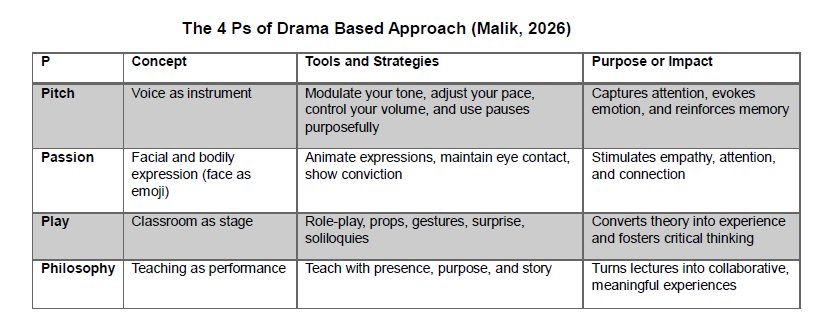
Measuring Impact?
Does DBP simply entertain? Evidence shows it enhances learning (Robson, Krolikowska & Williams, 2025). Neuroscience confirms that emotions strengthen memory, and performance-driven teaching deepens understanding through multisensory engagement (Tyng et al., 2017). Far from weakening rigor, the approach anchors knowledge, sparks curiosity, and challenges assumptions.
Beyond the Lecture Hall – The University’s Role
Drama enhances academic integrity and reinforces the purpose of education. Today’s educators can no longer rely solely on delivering information, and universities cannot assume that the AI revolution will disappear.
Universities must rethink their role and focus on:
- Philosophical shift – making lecture delivery a central part of the university experience. Students seek connection, inspiration, and mentorship, experiences that AI cannot replicate.
- Redefining and renegotiating the meaning of education in collaboration with students, ensuring learning remains relevant, dynamic, and shared.
- Prioritizing student satisfaction, engagement, mentorship, and motivation, with learning outcomes and academic results emerging naturally from these deeper connections. Xu et al. (2023) found that student engagement strongly predicts learning outcomes.
Effective teaching is a performance. It demands voice, energy, passion (what I call a “magical fire”), facial expression, storytelling, presence, and emotional resonance. This level of engagement can only be achieved if universities worldwide treat these skills as essential rather than optional, embedding them into the core of teaching.
Conclusion:
Teaching is not about delivering content; it is about creating moments of transformation. When education becomes performance, learning becomes unforgettable. The lecture hall is a stage, a theatre of creativity where ideas come alive. As Shakespeare wrote in As You Like It, “All the world’s a stage, and all the men and women merely players.”
Stay up to date
Subscribe to the free GESS Education newsletter and stay updated with the latest insights, trends, and event news every week. Your email address will remain confidential