Beyond the Desk: Empowering the Next Generation of Leaders Through Center‑Based Learning
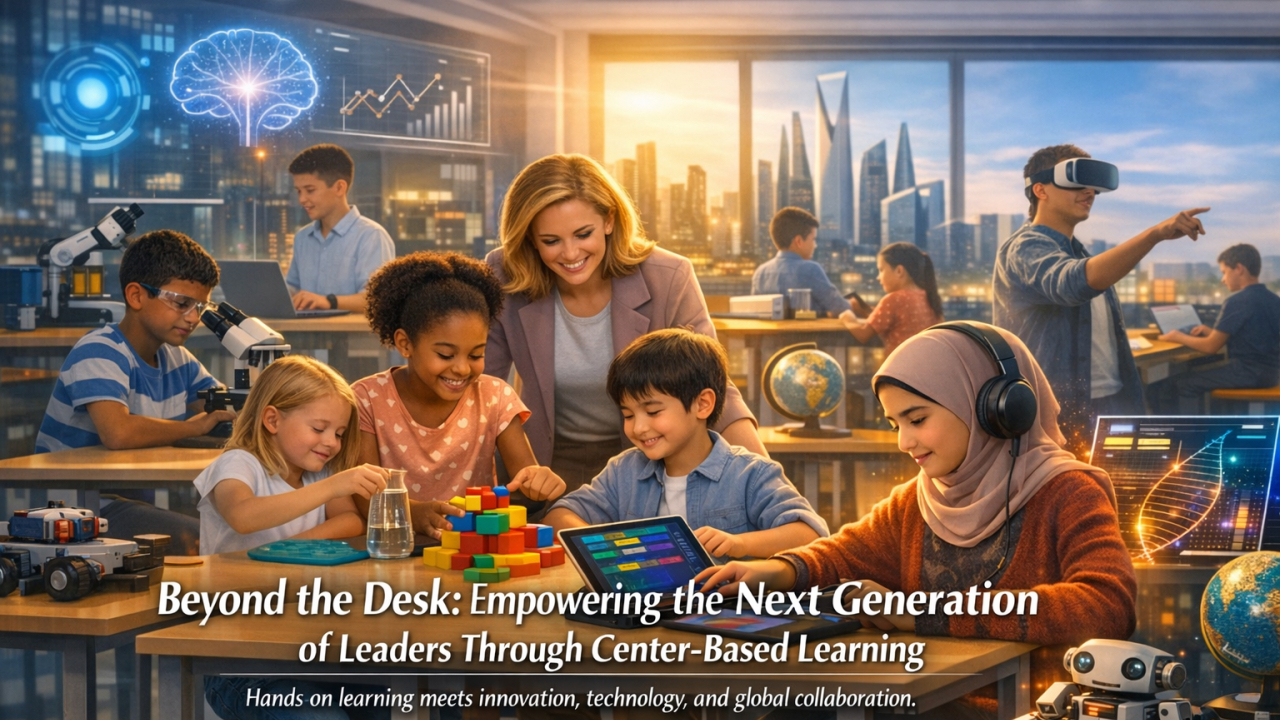
If you’ve ever watched a child completely absorbed in building a tower, mixing colors, or negotiating roles in a pretend play scenario, you’ve seen authentic learning. It’s focused, social, creative, and deeply meaningful. And it’s exactly the kind of learning that prepares young people for a world that demands flexibility, collaboration, and problem‑solving.
Across Saudi Arabia and especially within the innovative community at Riyadh Schools – Hittin educators are embracing this truth as they rethink what classrooms should look like in the era of Vision 2030. The shift is unmistakable fewer rows of desks, more movement, fewer worksheets, more inquiry, fewer teacher monologues, more student voices.
Center‑based learning sits at the heart of this transformation. It’s not new, but it’s newly essential. And when done well, it becomes the bridge between traditional teaching methods, emerging technologies, and the future‑ready skills our students need.
Why Center‑Based Learning Works for Today’s Learners
Center‑based learning resonates because it mirrors how humans naturally learn through exploration, conversation, and hands‑on engagement. Research consistently shows that active learning environments support deeper understanding and stronger long‑term retention (NAEYC, 2020). But beyond the research, any teacher who has watched a student light up during a hands‑on task knows this intuitively.
What makes center‑based learning especially powerful is how seamlessly it integrates with a wide range of teaching approaches already familiar to educators.
It strengthens inquiry‑based learning.
Centers become mini‑labs where students test ideas, ask questions, and follow their curiosity.
It enhances project‑based learning (PBL).
Each center can support a different phase of a project research, design, writing, reflection.
It supports differentiated instruction.
Centers allow teachers to meet students where they are, academically and developmentally.
It complements direct instruction.
Mini‑lessons still matter centers simply give students a place to apply new learning immediately.
It strengthens social‑emotional learning (SEL).
Centers require collaboration, communication, turn‑taking, and conflict resolution (Center on the Developing Child, 2011)
Center‑based learning doesn’t replace other methods. It elevates them.
Center‑Based Learning Is NOT Just for Early Years
One of the biggest misconceptions is that center‑based learning is only appropriate for young children. In reality, the model works beautifully across all age groups from early years to high school because it taps into universal principles of human learning: autonomy, relevance, collaboration, and active engagement.
Here’s how it looks across different stages:
Early Years: Exploration and Foundations
In early childhood, centers support:
• Sensory exploration
• Language development
• Fine motor skills
• Social‑emotional growth
• Early numeracy and literacy
This is where the model is most familiar but it’s only the beginning.
Elementary School: Independence and Skill‑Building
For primary learners, centers shift from play‑based exploration to more structured, skill‑focused tasks.
Examples include:
• Math Centers: problem‑solving challenges, manipulatives, math games
• Reading Centers: guided reading, fluency practice, vocabulary tasks
• Science Centers: experiments, observation stations, data collection
• Writing Centers: drafting, editing, publishing tasks
Students rotate through tasks that build independence, stamina, and academic confidence.
Middle School: Collaboration and Critical Thinking
Middle schoolers thrive when learning feels relevant and social. Centers support:
• Debate stations
• Research hubs
• Lab investigation tables
• Creative design studios
• Peer‑feedback corners
Centers help adolescents manage time, collaborate effectively, and take ownership of their learning skills essential for the teenage years.
High School: Agency, Innovation, and Real‑World Application
High school centers look different, but the principles stay the same.
Examples include:
• STEM Innovation Labs for prototyping and engineering
• Literature Circles for discussion and analysis
• Career Exploration Centers with digital portfolios and research tasks
• AI‑Supported Research Stations
• Media Production Centers for podcasts, videos, and digital storytelling
At this level, centers mirror real‑world workspaces collaborative, flexible, and purpose‑driven.
Center‑based learning grows with the learner. It evolves, matures, and becomes more sophisticated over time.
Where Technology and AI Fit In: Enhancing, Not Replacing
One of the most exciting developments in education today is the thoughtful integration of technology and artificial intelligence. But here’s the key: tech should support center‑based learning, not overshadow it.
In a center‑based classroom, technology becomes a tool for empowerment not entertainment.
AI as a personalized learning partner
AI‑powered apps can adjust reading levels, offer math challenges, or provide language support tailored to each learner.
Tech‑enhanced inquiry centers
Students can:
• Record observations
• Scan QR codes for challenges
• Explore virtual science simulations
• Document learning through photos and videos
Creative digital expression
Students can:
• Create stop‑motion films
• Code simple games
• Produce podcasts
• Design digital art
AI for teacher efficiency
AI tools help teachers:
• Generate differentiated tasks
• Track student progress
• Translate instructions
• Create visual schedules
• Document learning
Technology expands what’s possible. It doesn’t replace the human heart of teaching.
A Pathway to Vision 2030 and Beyond
Center‑based learning is more than a teaching strategy. It’s a mindset, a commitment to honoring how humans learn best. It’s a belief that students deserve classrooms that feel alive, joyful, and intellectually rich.
By blending hands‑on learning with thoughtful technology integration, schools in Saudi Arabia are not only aligning with global best practices they are nurturing the next generation of leaders envisioned in Vision 2030. Leaders who can think critically, communicate effectively, collaborate with empathy, and adapt to a world that is constantly changing.
And perhaps most importantly, leaders who love learning.
By Lecia Posselt
Riyadh Schools Hittin Teacher
References
Black, P., & Wiliam, D. (2009). Developing the theory of formative assessment. Educational Assessment, Evaluation and Accountability, 21(1), 5–31. Center on the Developing Child. (2011). Building the brain’s “air traffic control” system: How early experiences shape the development of executive function. Harvard University. Copple, C., & Bredekamp, S. (2009). Developmentally appropriate practice in early childhood programs (3rd ed.). National Association for the Education of Young Children. National Association for the Education of Young Children. (2020). Advancing equity in early childhood education. NAEYC. OECD. (2019). OECD learning compass 2030: A series of concept notes. Organisation for Economic Co‑operation and Development. Vygotsky, L. S. (1978). Mind in society: The development of higher psychological processes. Harvard University Press. World Economic Forum. (2020). Schools of the future: Defining new models of education for the fourth industrial revolution. World Economic Forum.
Stay up to date
Subscribe to the free GESS Education newsletter and stay updated with the latest insights, trends, and event news every week. Your email address will remain confidential