Play Before Paper: Why Exploration Must Come Before Formal Learning
In today’s rapidly changing educational landscape, the pressure to prepare young children for academic success is increasing. Parents often ask, “Is my child writing sentences yet?” “Can they read independently?” “Are they doing enough worksheets?” Schools too face expectations to demonstrate measurable progress, assessment outcomes and evidence of learning.
However, in the Early Years Foundation Stage (EYFS), one fundamental truth remains unchanged: Children do not learn best when they are pushed into formal learning too soon; they learn best when they are given opportunities to explore, investigate, create and play.
Play is not a break from learning. Play is the foundation upon which meaningful learning is built. Before children hold a pencil confidently, they need opportunities to strengthen their fine motor skills through building blocks, threading beads, manipulating playdough and exploring sensory materials. Before they write stories, they need experiences that develop vocabulary, imagination and communication. Before they solve complex mathematical problems, they need time to experiment with patterns, quantities, shapes and relationships. In the early years, exploration must come before explanation, curiosity before compliance, and play before paper.
The Changing Landscape of Early Childhood Education
Across many early childhood settings, there is a growing concern that formal academic expectations are moving into younger age groups. Children who are naturally designed to learn through movement, interaction and discovery are increasingly introduced to lengthy periods of sitting, writing and completing worksheets. While early literacy and numeracy development are essential, the method through which these skills are introduced matters greatly. A child in EYFS is not an unfinished primary school pupil. They are a unique learner at a crucial stage of development where their brain is rapidly forming connections through experiences.
A four-year-old who spends time building a tower, negotiating roles in a pretend restaurant, investigating insects outdoors or experimenting with water flow is developing: problem-solving skills, language and communication, creativity, collaboration, resilience, critical thinking, self-regulation and mathematical understanding. These are not “extra skills”; they are the foundations required for lifelong learning.
Play Is the Child’s Natural Language
Children make sense of the world through play. For young learners, play is how they ask questions, test ideas, express emotions and understand relationships. When a child says: "I am building a hospital for the injured animals," they are not simply playing with blocks. They are: designing and constructing (Understanding the World), developing spatial awareness (Mathematics) , explaining their ideas (Communication and Language) , showing empathy (Personal, Social and Emotional Development) and using imagination and creativity (Expressive Arts and Design). A simple play experience becomes a rich learning opportunity when adults observe carefully and provide meaningful interactions.
Example from EYFS: The Block Area as a Learning Laboratory
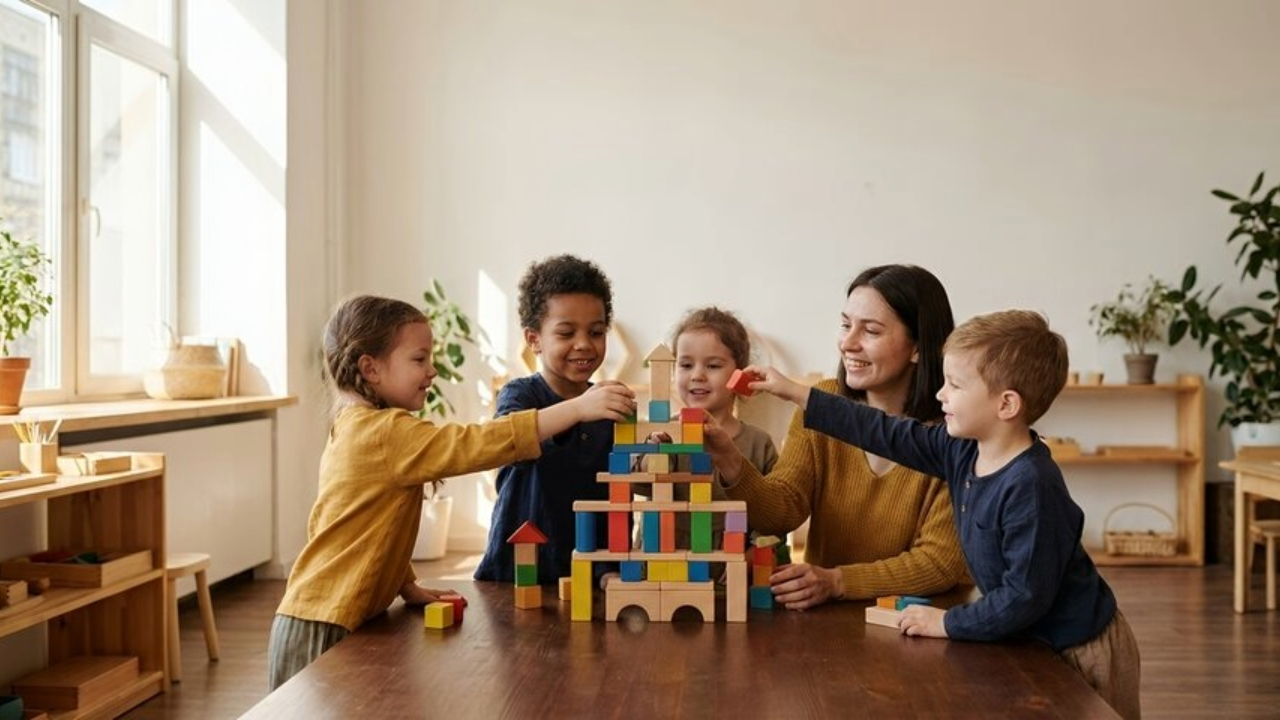
A child enters the construction area and begins building a tall tower. At first glance, it may appear that the child is “just playing”. However, a skilled EYFS practitioner recognises multiple layers of learning. The child is:
Mathematics--comparing height, exploring balance and stability , counting blocks , recognising shapes and estimating size.
Communication and Language--The teacher asks:“What are you building?” “How will you make it stronger?” “What could you add to solve this problem?” The child develops vocabulary such as strong, taller, heavier, wider, support and balance.
Personal Development--When the tower collapses, the child learns perseverance: "My tower fell. I need to try another way." This moment develops resilience far more effectively than completing a worksheet about problem-solving.
The Role of the Adult: From Instructor to Facilitator
Play-based learning does not mean children are left without guidance. High-quality EYFS practice requires thoughtful adult involvement. The educator’s role is to: observe children’s interests, provide carefully planned environments, introduce new vocabulary, extend children's thinking, ask meaningful questions and create opportunities for challenge. The most effective learning happens when adults know when to step in and when to step back. For example, during a water exploration activity, children may be pouring water between containers. A less effective approach may be: "This container holds 500 ml. Write the answer." A play-based approach might involve asking: "Which container do you think will hold the most water? How could we find out?" The children begin predicting, testing, comparing and explaining their ideas. The learning is deeper because it begins with curiosity.
Why Paper comes later
Writing is an important skill, but it requires many developmental foundations. Before a child can write their name, they need: strong hand muscles , pencil control , coordination , visual tracking, confidence in mark-making and understanding that marks communicate meaning. These skills develop naturally through experiences such as: painting with different tools, drawing in sand , using tweezers to sort objects , threading activities , building with construction materials and outdoor climbing and balancing . A child who spends time strengthening these foundations will often become a more confident writer than a child who is rushed into handwriting practice without readiness.
Example: Literacy Through Play
Imagine an EYFS classroom where children create a “travel agency” role-play area. Children design passports, make tickets, create maps and pretend to travel to different countries. Through this experience, they develop:
Communication and Language--"Welcome to Dubai Airport. Where would you like to travel?"
Literacy--writing names, recognising letters, creating signs, developing storytelling
Understanding the World--learning about different cultures, exploring maps . discussing countries
Mathematics--counting tickets , comparing prices , organising information
A child who writes a pretend boarding pass because they have a purpose is developing a deeper connection with writing than a child completing repeated letter formation sheets without meaning.
The importance of protecting childhood
Childhood is a unique stage that cannot be repeated. The early years should not become a race towards academic milestones. When children have opportunities to play, they develop the confidence to become: curious learners, creative thinkers, independent problem-solvers and emotionally secure individuals. The goal of EYFS is not simply to produce children who can read early or write neatly. The goal is to nurture children who love learning. A child who enters formal education with curiosity, confidence and resilience possesses something far more valuable than early academic achievement alone.
Balancing expectations: play and progress can coexist
Protecting play does not mean reducing expectations. In fact, effective play-based learning requires intentional planning, skilled teaching and careful assessment. An outstanding EYFS environment combines: child-led exploration + adult guidance, creativity + curriculum goals, freedom + purposeful learning and play + progress. The question should not be: "How quickly can we move children towards formal learning?" Instead, we should ask: "How can we create experiences that make children eager to learn?"
Let children play, let children learn. In the early years, play is not preparation for learning. Play is learning. Every block built, every story created, every question asked and every investigation explored contributes to a child’s development. Before children fill pages with writing, they must first fill their minds with experiences. Before paper, there must be play. Because when we protect play, we protect the very foundation of learning.
By Remediana Dias
Stay up to date
Subscribe to the free GESS Education newsletter and stay updated with the latest insights, trends, and event news every week. Your email address will remain confidential