Decision by Design: Why Schools Must Stop Copying Success and Start Designing It
Education has never suffered from a lack of ideas.
Every year, new frameworks, innovative models, and successful school improvement strategies emerge from different parts of the world. Finland inspires us, Singapore challenges us, the UK experiments with new leadership structures, and the US develops new instructional models. International schools introduce new curricula and pedagogical approaches.
Yet despite this abundance of innovation, many schools continue to struggle with sustainable improvement.
The question is no longer whether good ideas exist.
The real question is:
Why do successful ideas often fail when they move from one school to another?
This question sits at the heart of school improvement, and it is one that educators, leaders, and policymakers must begin to confront more honestly.
The Hidden Problem in School Improvement
In many cases, schools adopt models that have already proven successful elsewhere.
A leadership model that worked in one country.
A curriculum framework that improved results in another.
A teaching strategy that transformed learning in a particular school.
The assumption is simple and understandable:
If it worked there, it should work here.
But education is not that simple.
Schools are not identical systems, and improvement cannot be imported like a ready-made product. Every school operates within its own unique ecosystem — shaped by culture, leadership, student needs, teacher capacity, community expectations, and institutional structures.
What works in one environment may fail in another, not because the idea is weak, but because the context is different.
This is where many well-intentioned improvement efforts begin to lose their impact.
When Good Ideas Become Weak Decisions
In organizational psychology, there is a concept known as institutional isomorphism — the tendency of organizations to copy each other in order to appear legitimate or progressive.
In simpler terms, institutions often adopt similar practices not necessarily because they are effective, but because they are widely accepted.
Education systems are not immune to this.
Schools sometimes implement initiatives because they are globally recognized, internationally promoted, or widely adopted, rather than because they are deeply suited to their local reality.
This creates a quiet but dangerous gap between intention and impact.
On the surface, schools appear innovative.
In practice, they may struggle with implementation, teacher engagement, or long-term sustainability.
The result is not always failure — but something more subtle:
The appearance of improvement without the substance of improvement.
The Importance of Context
One of the most overlooked truths in education is that context shapes success.
A strategy that motivates students in one school might confuse them in another. A leadership approach that empowers teachers in one environment might overwhelm them in another.
A curriculum innovation that drives results in one system might create resistance in a different cultural setting.
Human behavior, organizational culture, and learning environments are deeply influenced by context.
For example, a school may introduce project-based learning because it has been successful internationally. However, without sufficient teacher training, clear assessment structures, and gradual implementation, the initiative may create confusion rather than innovation. Teachers may feel overwhelmed, students may struggle with expectations, and leaders may misinterpret the results. The idea itself is not flawed — the design of the decision is.
This means that copying solutions without adapting them is not innovation — it is replication without understanding.
And replication without understanding rarely leads to sustainable change.
From Copying to Designing
If copying solutions is not the answer, then what is?
The answer lies in shifting from copying success to designing success.
Instead of asking: What works elsewhere?
Schools should begin asking: What works here, and how do we discover it?
This shift changes everything.
It transforms school improvement from a process of adoption into a process of experimentation, reflection, and evidence-based decision making.
Teachers test ideas in classrooms.
Leaders evaluate real outcomes.
Schools refine strategies based on local evidence.
Improvement becomes a living process rather than a fixed model.
Decision by Design: A Practical Framework
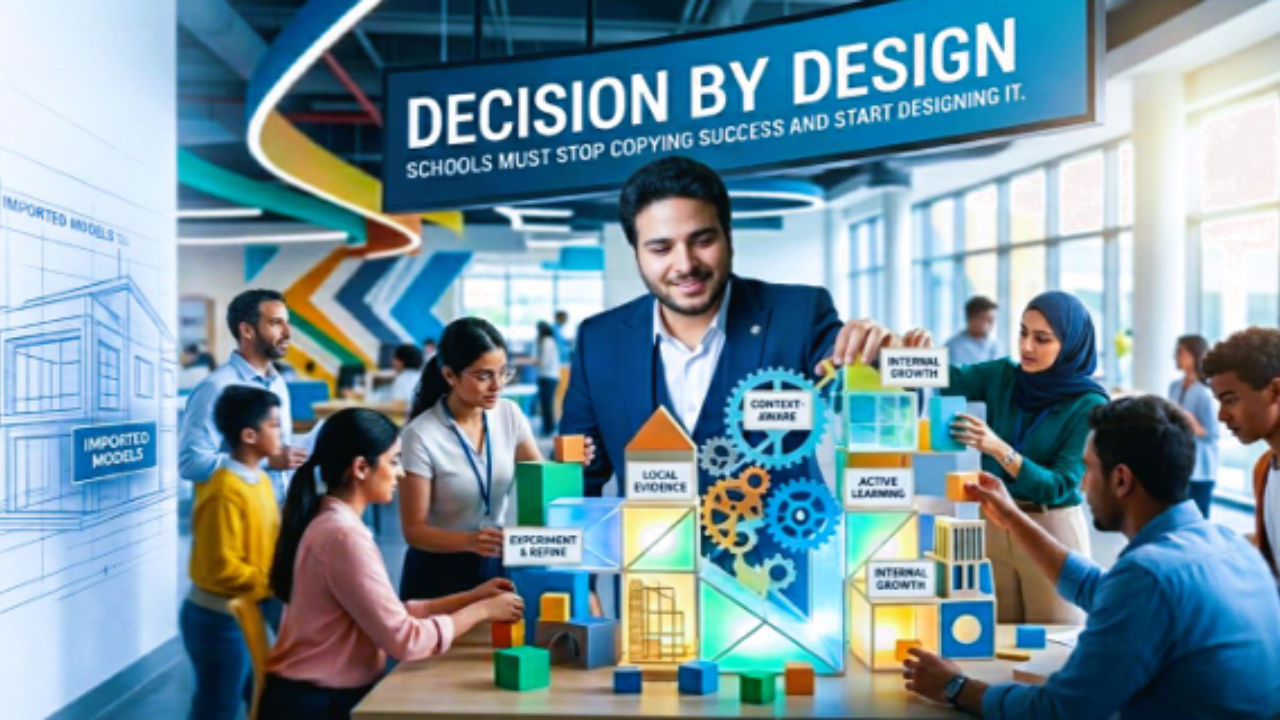
Decision by Design is not a model or a fixed framework. It is a mindset that encourages schools to think like researchers, experiment like innovators, and decide like leaders.
At its core, the concept is simple:
Better decisions come from local evidence, not imported assumptions.
The framework operates through four practical steps:
1. Identify a real problem within the school or classroom
2. Run small, low-risk experiments to test possible solutions
3. Collect feedback and evidence from real practice
4. Scale what works and refine what doesn’t
This approach allows schools to move from passive implementation to active learning.
Instead of copying improvement, they begin designing it. Instead of following trends, they build evidence.
Instead of applying external pressure, they create internal growth.
Why This Matters Now
Education today is evolving rapidly.
New technologies, new curricula, new leadership models, and new expectations are reshaping schools across the world.
In this fast-changing environment, the temptation to copy successful systems will only increase.
But sustainable improvement will not come from imitation alone.
It will come from thoughtful, context-aware, and evidence-driven decision making.
Schools must become learning organizations — not only for students, but for themselves.
They must experiment, reflect, adapt, and design their own path toward excellence.
Because the future of education will not belong to schools that copy success.
It will belong to schools that design it.
Schools that observe carefully.
Schools that experiment responsibly.
Schools that make decisions based on evidence rather than imitation.
Because in the end, sustainable improvement is not imported.
It is designed, tested, and built from within.
By Osama Abdullah
This article reflects the core ideas that will be discussed during my session at GESS Saudi Arabia, where the focus will be on how educators and school leaders can design smarter decisions and build sustainable improvement within their own contexts.
Osama Abdullah is an educator and academic leader with experience in school improvement, curriculum development, and educational leadership. He is an international conference speaker focusing on decision-making in education and sustainable school improvement.
Stay up to date
Subscribe to the free GESS Education newsletter and stay updated with the latest insights, trends, and event news every week. Your email address will remain confidential